Tuesday, 19 January 2016

Takashi Ishida

Artist/film-maker Takashi Ishida makes abstract, ambiguous works, which blur the boundaries between painting, film, and installation based work. Ishida explores relationships between time, place, sound, and painting. Epic in nature, each work is a physical feat of endurance, the filming process documenting the artist’s movements across each space. Ishida is known to improvise his works, creating them through active experimentation and discerning meaning after. Often large scale, I view Ishida's multi-media work as an exploration of the metaphysical, both for the artist, in his intensive physical experience during the process of creation, and also for the viewer; who is confronted with a document of monumental endeavour. Time spells out the works process, and large scale visuals and sound occupy our senses.

In work to date, my process has been to create visuals which are then passively projected into/onto an environment. Ishida paints directly on/within the environment. This is filmed through stop frame animation with the end film documenting the process of the work. This document is often exhibited in gallery spaces alongside the physical objects/spaces he has transformed. In a way, these are artefacts, by-products of the primary outcome which is the film, the document of process. I am starting to find this in my own work, where my large scale Letheringham Lodge drawings are by-products of a time based process, almost like an empty drinks can, the drawings are containers for the substance which is contained within. The combined digital drawings and animations I create from these large images go on to further explore the process of time.

Ishida's work could be described as crude, not in terms of concept but of execution. These are not refined calligraphic brush-marks but fast broken deliberate stabs and swirls. The stop frame is sometimes disjointed and the edges of sets he may use to site his work within, sit within the borders of the picture plane. The artifice of the work is laid bare. This supposed crudeness emphasises the human, and to my mind makes them all the more accessible and resonant an experience.


Useful links to Ishida's work
http://yokohama.art.museum/eng/exhibition/index/20150328-369.html
https://www.youtube.com/watch?v=h3GDWwpE_KI&spfreload=10

Below are a selection of stills taken from Ishida's films.


Monday, 18 January 2016

Anthony McCall - Line Describing a Cone

Anthony McCall blurs the boundaries between film, sculpture and drawing, here the audience is invited to move through and interact with the work, challenging idea of a motionless spectator.

The projected beam slowly arcs until in a 30 minute cycle a cone is created, mist from a smoke machine gives the beam form, allowing it to carve a tangible path through its environment. The work is large scale and can be adapted to the environment in which it is exhibited. The traditional narrative concerns of filmic work is deminished, film is reduced to a basic measure of time. To my mind the work functions more like sculpture and invites comparison with the work of constructivist artists such as Naum Gabo.

McCall provides instructions of how the work is presented:
The proportions of this projection vary, but the scale is large. The base of the cone, an emerging circle of light projected onto the wall, is tall enough, at between eight and eleven feet, to fully incorporate several spectators, and the length of the beam may be anything from thirty to sixty feet. This three-dimensional object, like sculpture, calls for a mobile, participating spectator, and, like film, it takes time. To fully see the emerging form it is necessary to move around and through it, to look at it from the inside and from the outside.
(McCall 2004)
I look to continue experimenting with ways of  presenting my work so that the boundary between image and spectator may come progressively blurred.

Link to Line Describing a Cone
https://vimeo.com/29428835


Line Describing a Cone 1973

Other works include:
Face to face 2013
Installation hanger Bicocco 2009
Long film for four projectors 1974


New Abstractions

While I am now primarily focusing on creating abstractions from source material these images are purely abstract, being developed without a representational starting point. Created from indian ink I originally produced a set of abstract layers which were intended to be mixed with my Letheringham Lodge pencil drawings. However after experimenting in Photoshop I decided that the ink and the pencil  layers did not 'fit' and instead used a selection of the ink layers to make the digital paintings below. I have started work on further pencil drawings so that I have a wider base of source material from which to develop my Lodge animations.


Letheringham Lodge - Moving image

A work in progress this is the latest version of my Letheringham Lodge project. I feel some passages are working better than others and a few transitions still need tweaking. I intend to work on balancing tone in the images as I feel it can look flat in places. I will also look to include more sinuous branch like layers, I feel these work to lead the eye around the image, I also like how they make the image hover on the border between representation and abstraction.


LLOYD EVANS - Letheringham Lodge 1 from Lloyd Evans on Vimeo.

Framing the institution - The Diagram

I've been reading 'The Diagram' by Daniel Buren, in it he explores how the institution (Gallery/Museum)  frames artwork placed within it, validating it with context. He also considers how painting is based on illusion, the 'recto' reverse of the image being hidden by the canvas on the front, even before the artist employs any intended spacial illusions.

In my current work I have been playing with these ideas. By projecting onto the front of buildings such as the Town Hall in a way reverses roles, making the artwork frame the institution. Also in my paper based installations nothing is hidden, the reverse of the image appearing on the back of the picture plain, all be it as a mirror image.


Another link to Buren's conceptualisation is his use of repetition. while his the visual language he uses could be described as formal due to his use geometric forms (stripes) and opposite to my own, both practices rely on repetition of elements. I see repetition as a way to allude to the infinite, that beyond the picture plain, repetition implies more, infinity, the sublime.


Letheringham Lodge - Combined drawings

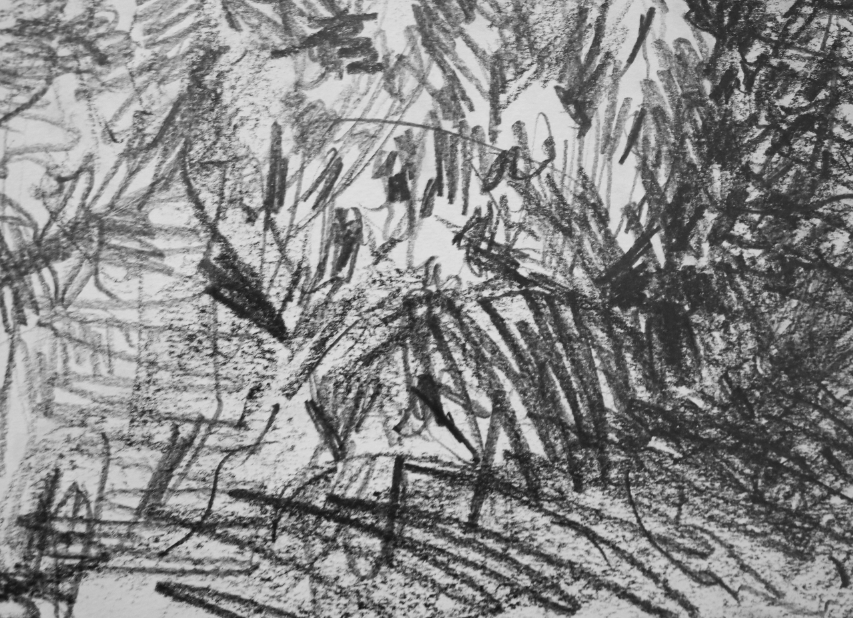
A selection of digital images created from photographs of my new pencil drawings, however I found that most of the new images were taken too close up.  This had the effect that line quality was not consistent and many of the layers were unusable. I intend to get all 4 large scale drawings digitally scanned so that I can easily crop small areas out of these master drawings to use in the construction of new combined drawings.


Letheringham Lodge - New drawings

Below are two new large scale drawings plus accompanying close up shots. These have been placed as individual layers in a master Photoshop document. From this document I intend to develop my Lodge animation and accompanying still images.